Showing posts with label bud. Show all posts

Thursday, August 13, 2009

Fuller Flower Development

by Richard Chew

After experimenting some ways to get long & short burst flower buds, I noticed it compromised fuller flower development. And very often the flower petals burnt when fertilizer dosage is too high.

I reasoned if I can maintain strong stem development but reduce the rate of flower bud development, I may get fuller flower development.

The following is some of the progress of my Fusilier Rose. Pay attention to the size and depth of flower petal.


Photobucket


Photobucket


Saturday, December 6, 2008

Its a Hot Tamale!!

by Richard Chew


I looked up the word 'Tamale' in the web and learned it is a kind of spicy Mexican dish.

However what I have here is a miniature rose known as Hot Tamale. It is called with this name, simply for its flower characteristics. It can grow up to a height of between 60cm to 90cm. The flower size is about 2 to 3 cm.


It has a unique bloom characteristics. Its petals are mainly orange red and its center is yellow in colour. It looks like lava glowing within the rose!


Gradually the orange colour fades and turn into pink, where as the yellow will fade into white. It is quite unusual.


I got my Hot Tamale bloomed with some flowers, unfortunately I didn't get this effect. The rose bud was already pink in colour when the bud started to open.


Below is picture taken at the following day. Fully opened and fully pink in colour, with darker pink veins appearing at the petals.


This is the side view. It has a nice full bloom. I wonder how it would really look like when a cluster of these miniature blooms burst out.


Earlier on (about 2 weeks earlier), I capture some photo shots on the shoots and new buds. I noticed some distortion on some leaves shape (not symmetrical). Though the leaves colour looked healthy, the distorted shape suggest that during the growth stage it lacks certain nutrients for stem and leave development.


Below is another closed up shot, and very obvious the shape of new young leaves looked odd, where as the older ones looked more symmetrical.

I believe this is due to some unsuccessful experiments (it was a trial and error thing) on the top soil, thus causes some 'bio-chemical' shock in the soil which affected the growth of the stem development.


However after correcting my soil, as I am writing this post, there were another 2 newer shoots. The newer shoots seemed to be doing well. Its leaves are darker tone (almost black) in colour , suggest it is growing well. Gradually the leaves will turn to lighter tone when its growth has reached maturity.


Below is another closed up shot. The little bud emerges. Notice the little 'bulge' at the tip of the stem?


Hopefully within 3 to 4 weeks time, I get to see the red hot lava flower bloom!

Other interesting things happened, decided to post it here.
I noticed a tiny weeny bug resting at the edge.


Remember the rotted chili that I used as fertilizer. The seed germinated! Initially I thought it was weeds, but soon realised it wasn't when I noticed it sprouted in clusters. I covered it, by over turning the soil.
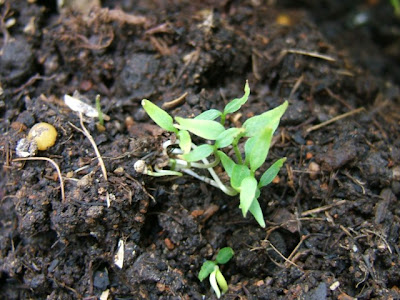


Well I got to wait for another few more weeks. Hopefully by Christmas, I wish....
HOT TAMALE .... FLAME ON !!


Thursday, November 6, 2008

Terminology for Cranberry Bud Development and Growth (EXT)

I extracted this from this from

http://www.hort.wisc.edu/cran/mgt_articles/articles_gen_info/TerminologyCranBudDev/cranbuddev.htm

I find this article interesting because it explains the different stages of bud development.


Beth Ann A. Workmaster, Jiwan P. Palta, and Teryl R. Roper
Department of HorticultureUniversity of Wisconsin-Madison College of Agriculture and Life Sciences, Madison, WI 53706


Cranberry researchers and growers typically use some sort of ad hoc terminology to refer to the growth stages of the bud in the springtime. This can be based on measurements of the changes in size of the bud and the subsequent growth, or on a description of their physical attributes, or morphology. It would be useful to standardize this terminology to aid in communication between and among researchers and growers. We have recently begun a research program at the University of Wisconsin-Madison to study cranberry frost survival. Our goal is to better advise growers about the freezing temperatures to which the plants will survive at different times of the year.


After taking close-up photographs of the buds of the uprights for several weeks in the spring of 1995 we established a visual continuum of spring bud development and growth. As expected, bud hardiness changed dramatically over the course of the spring, from being able to withstand temperatures colder than -4°F when dormant to surviving only temperatures just below freezing after the new uprights elongate. Thus, at different points along that bud developmental continuum significant changes in hardiness occur. In order to assess these changes more specifically we have been working on developing a useful set of terminology for these different bud stages.


The terminology we propose here was developed with input from growers at the 1995 summer field day of the Wisconsin State Cranberry Growers Association and researchers at the 1995 North American Cranberry Researchers and Extension Workers Conference. Our immediate goal for this terminology is to learn more about the relationship between bud stages and frost hardiness, while our longer term goal is to facilitate discussion between and among researchers and growers.


We have chosen to focus on describing the morphological changes in bud development and growth, rather than absolute changes in bud size or stem growth. Reproductive and vegetative buds vary in size, as does the amount of stem elongation during growth. Morphological changes, such as bud swelling and flower pedicel elongation, are more indicative of development than mere increase in size and length. We present here our current terminology. Each stage is represented by one or two pictures and is described below.


1. Tight bud. This is a resting bud that has fulfilled dormancy and chilling requirements. This bud becomes active when favorable growing conditions are present. Bud scales are tightly wrapped. Bud scales are usually light or dark red, especially in the upper part of the canopy. When viewed from the side, buds are compact and nestled down into the top leaves.


2. Bud swell. This bud is no longer at rest. As bud begins to swell, bud scales are pushed outwards and have a slightly loosened appearance. Bud scale margins are more easily seen. Most buds still retain their light or dark red color.


3. Cabbagehead. Substantial swelling of the bud has occurred. Bud scales are opening, but still enclose the new growth. As the name implies, this stage is named for the bud’s ressemblance to a head of cabbage. Many buds have lost much or all of their red pigment. When viewed from the side, buds appear pointy and lengthened, in preparation for the emergence of the new growth.


4. Bud break. New growth emerges through the bud scales. The tips of uppermost new leaves are visible.


5. Bud elongation. New leaves and some flower bracts, which envelope the flower buds, emerge from the bud. All new growth is held tightly and parallel to the stem.


6. Roughneck. Stem elongates significantly. All flower buds and bracts are visible, being held tight to the stem. New leaves are still oriented parallel to the stem. Flower pedicels have not elongated.


7. Hook. Flower pedicels elongate, starting with the lowest flower buds on the upright. The flower bud droops, forming the characteristic hook shape. New leaves are becoming more perpendicular to the stem.


8. Bloom. Flowers open, starting from the lowest buds.