Showing posts with label nitrogen. Show all posts

Monday, August 31, 2009

How To Determine Ammonium/Nitrate Ratio [EXT]

This is good article to understand the impact of low/high Ammonium/Nitrate Ratio.


How To Determine Ammonium/Nitrate Ratio


Nitrogen is the building block of amino acids, proteins and chlorophyll. Plants can absorb nitrogen either as Nitrate (NO3-) or Ammonium (NH4+), and therefore, the total uptake of nitrogen usually consists of a combination of these two forms.

The ratio between Ammonium and Nitrate is of a great significance, and affects both plants and soil/medium.

For optimal uptake and growth, each plant species requires a different ammonium/nitrate ratio. The correct ratio to be applied also varies with temperature, growth stage, pH in the root zone and soil properties.


Monday, July 13, 2009

The Carbon/Nitrogen Ratio

I found the way to calculate carbon nitrogen ratio and help me determine the amount to mix.

http://www.organicgardening.com/featureprint/1,7759,s1-5-21-112,00.html


Put your math skills to work and figure out if your compost has a balanced carbon to nitrogen ratio.

The carbon/nitrogen ratio

If you are a compost nerd, you might already know that the ideal ratio of carbon to nitrogen in a compost pile is about 30:1. A pile with that balance of materials will rot steadily, and it will yield nutrient-rich compost.

But how do you know what your pile's ratio is? "The most important factor in estimating the carbon-to-nitrogen ratio is how much water is present," explains Eric Evans, Ph.D., laboratory director of Woods End Research Laboratory in Mt. Vernon, Maine. "Dry materials are generally in the range of 40 to 50 percent carbon, and sloppy, wet materials are generally 10 to 20 percent carbon." Here are the specifics on many common materials. After you've scanned through these, you'll see how to calculate your pile's exact Carbon/Nitrogen ratio.


Do the math
To calculate the carbon-to-nitrogen of your compost mix, use the chart above to find the approximate percentages of carbon and nitrogen in your ingredients. Even if you're unlikely to weigh every ingredient you add to your heap, this formula will give you an idea of how to adjust the proportions of materials in your pile to get finished compost more quickly.

1. Calculate your pile's Total Carbon Value by multiplying the percent carbon of each ingredient by the number of parts (by weight) of that ingredient and then adding up the carbon totals for all the ingredients
2. Do the same for the nitrogen.
3. Divide the carbon by the nitrogen to get the C:N ratio. If it's between 25 and 35, your pile should compost beautifully. If the ratio is higher or lower than that, adjust the proportions of ingredients to bring it into the range of 25 to 35 parts carbon for each one part nitrogen.

Here's an example of how the carbon-to-nitrogen ratio works when you apply the formula to real-life amounts of real-life compost ingredients:

Starting with 50 pounds of nonlegume hay, 10 pounds of kitchen scraps, and 2 pounds of coffee grounds:
50 lbs hay x 40% C = 20 lbs. C
10 lbs kitchen scraps x 10% C = 1 lb. C
2 lbs coffee grounds x 25 % C = 0.5 lb. C
20 + 1 + 0.5 =21.5 Total Carbon Value

50 lbs hay x 1% N = 0.5 lb. N
10 lbs kitchen scraps x 1% N = 0.1 lb N
2 lbs coffee grounds x 1 % N = 0.02 lb. N
0.5 + 0.1 + 0.02 = 0.62 Total Nitrogen Value

21.5/0.62= 34.7 parts carbon to 1 part nitrogen

Wednesday, November 26, 2008

Dealing with cholorotic Nozomi Rose

by Richard Chew


At this time of writing this posting, I am still finding ways to overcome chlorosis at my Nozomi Rose. Though infected with chlorosis, the stems looks healthy so there is still some good chance to recover this rose.


I replaced the top soil with more acidic organic matter. I used peat moss with mixture of grass clippings to aid aerobic decomposition.


Another ingredient that I add into the mixture were chili in slices . I chose chili because I have abundance of it grown at my garden. Chili like any fresh vegetable has 25:1 carbon nitrogen ratio. I particularly plugged the rotted ones, as they have lower carbon nitrogen ratio which makes it easier to decompose.


I've checked other resources for advise to treat chlorosis. In general the most acceptable advise are to spread sulfur or squeeze lime on to the soil to increase the acidicty. Basically acidicty of soil helps the roots to absorb iron. However most also commented that the results will not be immediate, it will take time for the bacteria to react after the application of sulfur or lime.


I felt that instead of adding sulfur that may interupt the microbial soil organism; and squeezing lime may have temporal effect, as it may leached by the expected monsoon rain in the coming months. I felt using urea will be a better alternative, as it not only improves soil acidicty, it has another plus factor that it increases the supply of nitrogen in soil.


Plants needs nitrogen to build cholorophyll cell at the leaves. Although chlorotic plants are usually associated with iron defiency, there is sufficient research to confirm its relation with nitrogen defiencies. Basically chlorotic plants needs very little amount of iron to build cholorophyll cells in new leaves. There is suggestions that very likely the required iron is so little that the soil may have sufficient iron to fulfill the plants needs.

The main problem is likely due to the inability of plant roots to absorb the ferum ions in soil. By increasing the supply of nitrogen, this will aid rizhosphere (bacteria that lives at plant roots) to accumulate iron for root uptake. I also learned that increased of phosporus will affect the uptake of iron in the roots.

Just to experiment the effectiveness of this treatement, I applied a teaspoon of urea at the outer perimeter on the top soil to avoid burning the roots and main stem. When it fully dissolved into the soil, I gradually mixed it with the rest at top soil, . Hopefully in a month time, more darker green shoots will appear.


Click to continue Part 2

Saturday, November 22, 2008

Feeding the Soil - Part 4

by Richard Chew


After my previous improvements as posted in Feeding the Soil - Part 3, there is marked improvement, but I was still not very satisfied with the rate of decomposition.


Upon learning that peat moss helps decrease pH of soil and also increase rate of decomposition of organic matter, I decided to add peat moss as top soil. Peat moss has carbon nitrogen ratio of 50:1. And it has higher population of actinomycete bacteria that is responsible to decompose organic matter. This decomposition process is also known as mineralization of organic matter that converts organic matter into non-organic ammonia mineral. Subsequently ammonia is used by other bacterias for their metabolic activities, also known as nitrogen fixing. During the metabolic activities, these bacteria will respire nitrogen into a form that can be taken in by plant roots as nutrients.


The peat moss also aids in decomposing dry fertilizer (pellets form - chicken and sheep manure), including those that are highly processed which are harder to decompose. Mixing dry fertilizer with the peat moss, will help to break down the fertilizer more easily thus faster release of needed nutrients into the soil. Without peat moss (or any substance that aids decomposition), the bacteria may draw nitrogen from the soil to break down the fertilizer. This is the reason why the dosage of fertilizer must correspond with the size and health of the plant. Otherwise both the fertilizer and the plant roots would be competing for the same source of nitrogen. To build on that, if the plant roots are not healthy, the same bacteria that decompose the organic matter may choose to 'attack' the roots instead because the unhealthy roots become easier to break down.


However peat moss need to be mixed with other low carbon nitrogen ratio matter to create a better soil metabolic effect. Peat moss by itself, tends to retain too much moisture and may invite more fungal decomposition. Its surface tends to be grayish (sign of fungal). Of course retaining moisture has it benefits, but if too much may tightened the top soil that impedes aeration especially after heavy rain fall. Too high moisture content will lead to anaerobic fermentation, because the soil structure lacks access to O2 thus will increase the soil pH (alkaline soil). This probably explains the cause of chlorosis at my Nozomi rose which is sign of suffering from the inability to absorb iron. More about my experience in countering chlorosis in my next posting.


Having mentioned the above I need to clarify that the grayish texture at the peat moss surface is not a bad sign. It actually confirms the presence of actinomycete, a kind of fungal bacteria (because it is fillimous, and has spores) for decomposing organic matter. If its high with actinomycete, don't be surprise a mushroom may suddenly spring up from the soil in the early morning.


To prevent or to minimise anaerobic fermentation (that will increase soil pH), we need to add material that provide good top soil structure for better aeration to aid aerobic decomposition. And it should contain low carbon so that metabolic activities can be raised without depleting nitrogen at the top soil.


I used grass cuttings. It is inexpensive. It cost about RM2.60 per pack. It has the right carbon nitrogen ratio (20:1), that utilises nitrogen from its own source when decomposing. And its structure goes well with peat moss to improve top soil aeration. I would mix about 50% (of volume, not weight) with the peat moss. I noticed a dramatic difference in the soil structure after mixing it with grass cuttings.


The top soil becomes less tight, much softer and more fluffier (better aeration). I noticed it becomes brownier (and less grayish) when I turn over the top soil on the following day This is good sign of good compost soil.


I have just pruned my Portmeirion rose. I did the top soil as mentioned above. Hopefully by Dec I will get good display of flower. The rose is responding well with some buds at the main stem. Hope to get about 10 strong shoots for flowering.


Thursday, November 13, 2008

Compost Fundamentals: Compost Needs - Carbon Nitrogen Relationships [EXT]

I extracted this from http://whatcom.wsu.edu/ag/compost/fundamentals/needs_carbon_nitrogen.htm


This posting gives you an idea of using the right combination of fertilzer to achieve optimal results


There are some essential factors involved in determining what type of pile to build and how to manage the feedstocks. Organisms cannot decompose organic material as efficiently without certain requirements, such as air, water and appropriate particle size. Following are the most important considerations.

carbon-nitrogen relationships


The course of decomposition of organic matter is affected by the presence of carbon and nitrogen. The C:N ratio represents the relative proportion of the two elements. A material, for example, having 25 times as much carbon as nitrogen is said to have a C:N ratio of 25:1, or more simple, a C:N ratio of 25. Actually, the ratio of available carbon to available nitrogen is the important relationship because there may be some carbon present so resistant to biological attack that its presence is not significant.
Organisms that decompose organic matter use carbon as a source of energy and nitrogen for building cell structure. They need more carbon than nitrogen. If there is too much carbon, decomposition slows when the nitrogen is used up and some organisms die. Other organisms form new cell material using their stored nitrogen. In the process more carbon is burned. Thus the amount of carbon is reduced while nitrogen is recycled. Decomposition takes longer, however, when the initial C:N ratio is much above 30.
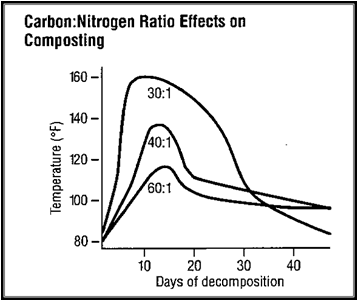


In the soil, using organic matter with excess carbon can create problems. To complete the nitrogen cycle and continue decomposition, the microbial cells will draw any available soil nitrogen in the proper proportion to make use of available carbon. This is known as "robbing" the soil of nitrogen, and delays availability of nitrogen as a fertilizer for growing plants until some later season when it is no longer being used in the life-cycles of soil bacteria.

When the energy source, carbon, is less than that required for converting available nitrogen into protein, organisms make full use of the available carbon and get rid of the excess nitrogen as ammonia. This release of ammonia to the atmosphere produces a loss of nitrogen from the compost pile and should be kept to a minimum.

A C:N ratio of 20, where C and N are the available quantities, is the upper limit at which there is no danger of robbing the soil of nitrogen. If a considerable amount of carbon is in the form of lignin or other resistant materials, the actual C:N ratio could be larger than 20. The C:N ratio is a critical factor in composting to prevent both nitrogen robbing from the soil and conserving maximum nitrogen in the compost..

Since organisms use about 30 parts carbon for each part of nitrogen, an initial C:N (available quantity) ratio of 30 promotes rapid composting and would provide some nitrogen in an immediately available form in the finished compost. Researchers report optimum values from 20 to 31. A majority of investigators believe that for C:N ratios above 30 there will be little loss of nitrogen. University of California studies on materials with a initial C:N ratio varying from 20 to 78 and nitrogen contents varying from 0.52% to 1.74% indicate that initial C:N ratio of 30 to 35 was optimum. These reported optimum C:N ratios may include some carbon which was not available. Composting time increases with the C:N ratio above 30 to 40. If unavailable carbon is small, the C:N ratio can be reduced by bacteria to as low a value as 10. Fourteen to 20 are common values depending upon the original material from which the humus was formed. These studies showed that composting a material with a higher C:N ratio would not be harmful to the soil, however, because the remaining carbon is so slowly available that nitrogen robbery would not be significant.

CARBON NITROGEN (C:N) RATIOS IN FEEDSTOCKS

Plant residues are made up largely of the following:

1. sugar, starch, simple proteins (decompose rapidly)
2. crude protein (decompose slowly)
3. hemicellulose (decompose slowly)
4. cellulose (decompose slowly)
5. lignin, fat, wax, etc. (decompose slowly)

Rate of decay and release of nutrients to the soil vary greatly. Likewise, demands of living soil microorganisms vary as they "break down" plant residue. Sawdust (made primarily of lignin and cellulose) uses vast amounts of energy to maintain the lives of microorganisms digesting it. A major product of plant decay is nitrogen (N) while the undigested portion is primarily carbon (C).
The optimum ratio in soil organic matter is about 10 carbons to 1 nitrogen, or a C:N ratio of 10:1.
Following are some sample C:N ratios of organic matter:

Sandy loam (fine) 7:1
Humus 10:1
Food scraps 15:1
Alfalfa hay 18:1
Grass clippings 19:1
Rotted manure 20:1
Sandy loam (coarse) 25:1
Vegetable trimmings 25:1
Oak leaves 26:1
Leaves, varies from 35:1 to 85:1
Peat moss 58:1
Corn stalks 60:1
Straw 80:1
Pine needles 60:1 to 110:1
Farm manure 90:1
Alder sawdust 134:1
Sawdust weathered 3 years 142:1
Newspaper 170:1
Douglas fir bark 491:1
Sawdust weathered 2 months 625:1